Recommender systems on social media increasingly mediate how users encounter mental health content, yet it remains unclear whether they distinguish help-seeking from distress expression. We conduct a controlled 7-day audit of TikTok's "For You" page using 30 fresh accounts and LLM-guided agents that vary initial search framing (distress- vs. help-initiated) and interaction strategy (engaged, avoidant, passive). Across 8,727 recommended videos, interaction behavior dominates exposure outcomes: engagement rapidly saturates feeds with mental health content (≃45% of daily recommendations), while avoidance and passive viewing reduce but do not eliminate exposure (≃11–20%). Search framing mainly shifts composition rather than volume—help-initiated searches yield more potentially supportive material, yet potentially harmful content persists at low but non-zero levels, including content in the Suicide/Self-Harm category. These findings suggest limited sensitivity to user intent signals in TikTok's recommendations and motivate context-aware safeguards for sensitive topics.
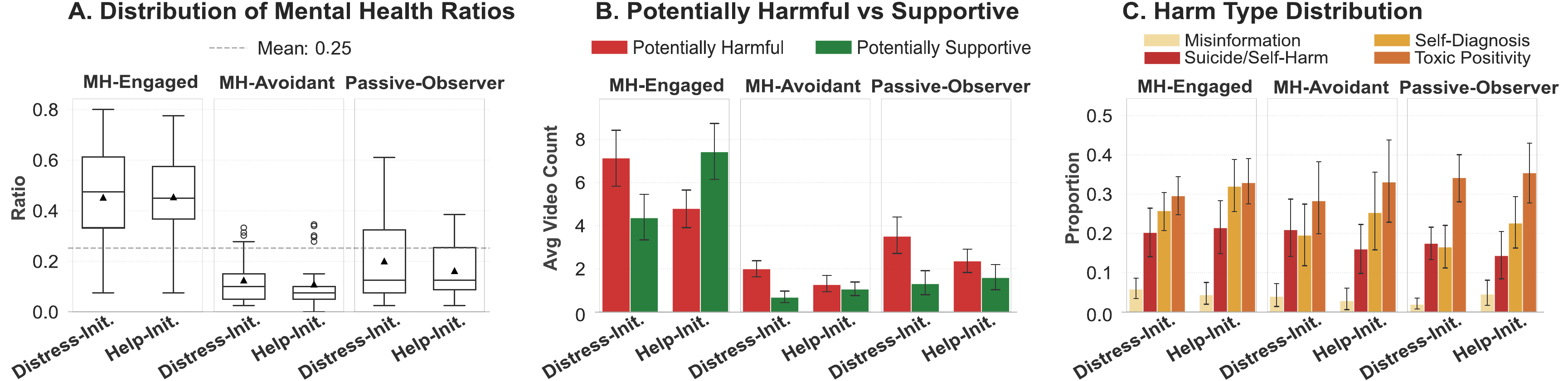
Cross-sectional exposure patterns across personas. (A) MH saturation (proportion of MH-relevant videos among 40 daily recommendations; dashed line is the global mean). (B) Average daily counts of potentially harmful vs. potentially supportive content. (C) Harm subtype proportions within potentially harmful content.
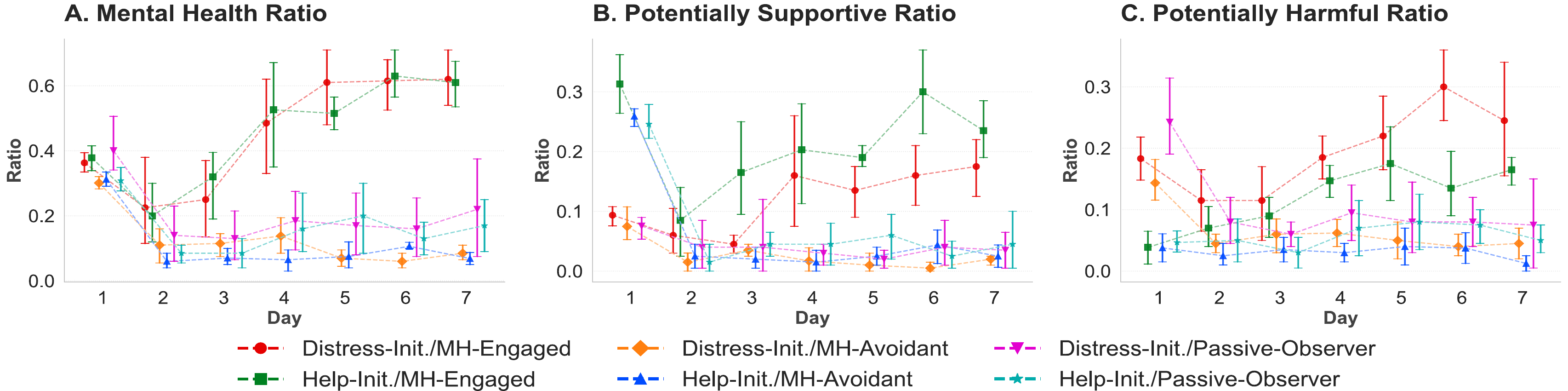
Feed evolution (Days 1–7). (A) MH ratio over time by persona. MH-Engaged saturates while MH-Avoidant and Passive-Observer drop after Day 1 but remain non-zero. (B) Potentially supportive and (C) potentially harmful ratios, with harmful exposure persisting across conditions. Error bars show 95% CIs.
References
2026
Seeking Help, Facing Harm: Auditing TikTok’s Mental Health Recommendations
Pooriya Jamie, Amir Ghasemian, and Homa Hosseinmardi
In Proceedings of the International AAAI Conference on Web and Social Media, 2026
Recommender systems on social media increasingly mediate how users encounter mental health content, yet it remains unclear whether they distinguish help-seeking from distress expression. We conduct a controlled 7-day audit of TikTok’s ’For You’ page using 30 fresh accounts and LLM-guided agents that vary initial search framing (distress- vs. help-initiated) and interaction strategy (engaged, avoidant, passive). Across 8,727 recommended videos, interaction behavior dominates exposure outcomes: engagement rapidly saturates feeds with mental health content (approximately 45% of daily recommendations), while avoidance and passive viewing reduce but do not eliminate exposure (approximately 11-20%). Search framing mainly shifts composition rather than volume—help-initiated searches yield more potentially supportive material, yet potentially harmful content persists at low but non-zero levels, including content in the Suicide/Self-Harm category. These findings suggest limited sensitivity to user intent signals in TikTok’s recommendations and motivate context-aware safeguards for sensitive topics.
@inproceedings{jamie2026seeking,title={Seeking Help, Facing Harm: Auditing TikTok's Mental Health Recommendations},author={Jamie, Pooriya and Ghasemian, Amir and Hosseinmardi, Homa},booktitle={Proceedings of the International AAAI Conference on Web and Social Media},volume={20},number={1},pages={2987--2995},year={2026},project={/projects/SeekingHelpFaceingHarm/}}